
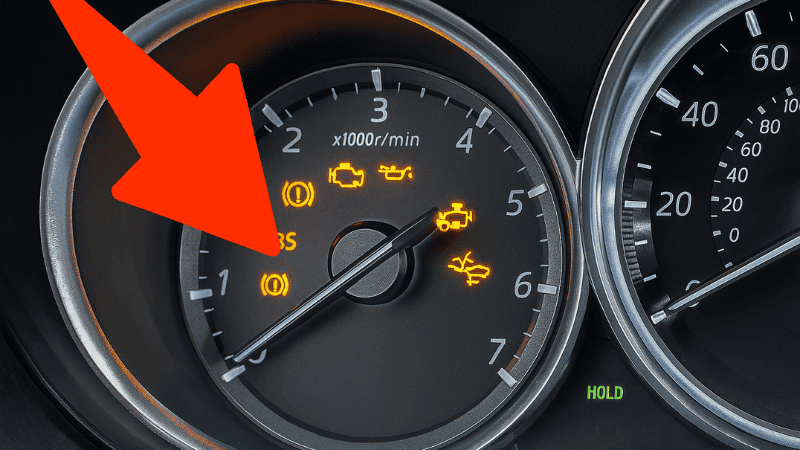
An ABS fault has a rude habit: it can let the car feel normal during easy stops, then disappear when panic braking demands help. The clearest ABS Module Symptoms include a steady ABS warning light, traction control alerts, wheels locking on wet pavement, odd pump noises, and a moment when the brake pedal feels hard instead of controlled. Your regular brakes may still stop the vehicle, but the antilock braking system may no longer pulse brake pressure to keep tires rolling. That changes how the car behaves on rain, ice, gravel, or broken pavement. For drivers reading plain-language auto repair guidance before calling a shop, the key is simple: do not judge this failure by normal neighborhood braking. Judge it by what could happen during a sudden stop at 55 mph. NHTSA explains that ABS works by reducing, holding, and reapplying brake pressure as a wheel approaches lockup, which is why a dead module matters even when the pedal still moves.
The Warning Lights That Make ABS Failure Look Smaller Than It Is
A dash light feels easy to ignore because the car still starts, shifts, steers, and stops. That is the trap. ABS faults often begin as a warning, not a dramatic breakdown. The system is telling you that its backup brain may not be ready for the one moment you cannot rehearse.
Why the ABS warning light should not be treated like a nuisance
The ABS warning light is the most common first clue, but it is also the easiest one to misread. Many drivers see it beside the tire pressure light, washer fluid reminder, or maintenance reminder and file it under “later.” That is a bad habit with brakes.
On startup, the ABS light should turn on for a short self-check and then turn off. If it stays on, comes back while driving, or appears with a chime, the system has seen a fault it cannot dismiss. Commercial brake safety guidance says an ABS lamp that stays on during self-test or appears while driving points to a malfunction that needs repair as soon as practical.
Here is the non-obvious part: the light does not prove the control unit itself is dead. It proves the network has lost trust in the system. A bad wheel sensor, weak voltage, corroded connector, pump motor fault, or internal module failure can all trigger the same amber light. That is why replacing the module first can be an expensive guess.
A real example helps. A driver in Michigan may see the ABS light after a week of slush, salt, and potholes. The brakes feel fine in the driveway. Then, on a wet freeway ramp, the right front wheel skids for a split second during a hard stop. That tiny moment is when the warning light becomes real.
When traction control and stability alerts join the problem
ABS does not live alone anymore. On many newer cars, the same wheel speed data supports traction control, electronic stability control, hill-start assist, brake force distribution, and sometimes adaptive cruise behavior. When the ABS module stops reading or sharing data correctly, other systems complain too.
That is why a single brake issue can light up the dash like a small holiday display. You may see ABS, traction control, stability control, and brake system warnings at the same time. The car is not being dramatic. These systems are connected through shared sensors and control messages.
The tension for owners is that the car may still feel normal in dry weather. No grinding. No smoke. No sinking pedal. Nothing that screams “tow truck.” That quiet feel can fool you into thinking the issue is electronic only.
But electronics control the pressure pulses that keep tires from locking during a panic stop. If the module cannot process wheel speed or command the hydraulic unit, the antilock braking system may step aside. The car can still brake, but it may brake like an older vehicle without anti-lock support.
A practical shop check starts with the scan report, not the light itself. Ask for the stored ABS codes, freeze-frame data if available, and which wheel or circuit the fault names. A vague warning is not enough. You need the story behind it.
ABS Module Symptoms That Hide Behind Normal Brake Feel
The confusing part is that a failing ABS module does not always make the pedal feel strange in ordinary traffic. You can back out of the driveway, stop at a sign, and pull into a parking space without drama. The failure shows up under pressure, when the system needs to think faster than your foot can react.
When the brake pedal feels hard at the wrong moment
A hard pedal can come from several places, including brake booster trouble, hydraulic faults, low voltage, or a module that cannot command the pump and valves the way it should. The phrase matters because when the brake pedal feels hard during an ABS event, the driver often pushes harder and expects the car to obey.
Sometimes it does not respond the way you expect.
In a normal ABS stop, you may feel pulsing, buzzing, or rapid feedback through the pedal. That sensation can be unsettling, but it usually means the system is doing its job. A dead or confused module may remove that feedback. Instead of a controlled pulse, the pedal can feel stiff, wooden, or oddly disconnected from the road surface.
That does not mean every firm pedal is an ABS module failure. A vacuum leak on a gas vehicle, a failed brake booster, or an electric brake assist issue on a hybrid can create a hard pedal too. The difference is context. If warning lights appear with scan codes for ABS communication, pump motor control, pressure sensor faults, or internal module errors, the module becomes a stronger suspect.
A counterintuitive point: a soft pedal is not the signature sign here. Many drivers expect brake failure to feel mushy or sink toward the floor. ABS control trouble can feel like the opposite. The pedal may feel firm because the system is no longer modulating pressure at the wheel that needs it.
Why wheel lock on wet pavement feels like an old-school brake problem
Wheel lock is the symptom that makes owners understand the risk fast. You brake hard on wet pavement, and one or more tires stop rolling. The steering gets light or useless for a moment. The car may push straight ahead even though your hands are turning the wheel.
That is the moment ABS was built to prevent.
NHTSA describes locked wheels as unstable because a sliding tire loses grip in all directions, while ABS is designed to control wheel slip by changing brake pressure during braking. When the control unit cannot make those pressure changes, tire behavior becomes more old-school. You are back to managing lockup with pedal feel, road feel, and luck.
Think about a rainy school pickup line in Georgia. A minivan ahead stops short because a child drops a backpack near the curb. You hit the brakes. At 18 mph, even a short skid matters because you have almost no room. ABS may not shorten every stop on every surface, but it helps you keep steering while braking. That steering window is the prize.
The non-obvious detail is that ABS failure can show up only on one corner first. A left rear sensor circuit or internal channel fault may cause one tire to behave worse than the others. The car may not skid evenly. It may tug, chatter, or drift under hard braking.
That uneven feel is not “road crown” or “cheap tires” until proven. It deserves a brake scan and a look at live wheel speed data.
What Usually Fails Before You Blame the Control Unit
It feels natural to blame the most expensive part when the dash says ABS. Shops see this all the time. Owners arrive worried about the control module, the pump, or a full hydraulic unit. Sometimes they are right. Often, the real failure is smaller, dirtier, and sitting closer to the wheel.
A wheel speed sensor fault can imitate a module failure
Wheel speed sensors tell the ABS module how fast each wheel is turning. If one sensor drops out, lies, or sends a choppy signal, the module has to decide whether the wheel is sliding or the data is bad. When it cannot trust the signal, it turns the system off and stores a code.
Mobil notes that ABS faults are often sensor or wiring related rather than the module itself, with debris, metal shavings, and damaged sensor wiring among common causes. That lines up with real repair bay life. A sensor lives near heat, water, grit, rust, road salt, and wheel movement. The module sits in a harsher job than people realize, but the sensor area takes daily abuse.
The best example is a rusty wheel bearing tone ring in the Midwest. The module may see a strange drop in wheel speed at low speed, think the wheel is about to lock, and trigger unwanted ABS action. The driver feels a buzz near the end of a gentle stop. It feels like a module problem, but the module may only be reacting to bad information.
That is why wheel speed sensor diagnosis should happen before anyone prices a control unit. Live data can show one wheel reading zero, jumping around, or lagging behind the others. A visual inspection can reveal broken wires near the knuckle, swollen connectors, rust flakes, or sensor tips covered in metal dust.
The unexpected lesson is that a smart module can look dumb when its senses are dirty. Bad input creates bad decisions.
Electrical power, grounds, and corrosion tell a quieter story
ABS modules are picky about voltage and ground quality. They need stable power to run logic circuits, command solenoids, operate pump motors, and talk to the rest of the car. A weak battery, failing alternator, loose ground strap, or corroded fuse box can make the system act haunted.
This is where owners lose money. A scan may show “module communication lost” or “internal fault,” and the first instinct is replacement. But if the module is starving for clean power, the code may be a symptom of the supply problem. The smarter path is boring: check fuses, relays, powers, grounds, connector pins, water intrusion, and charging voltage.
Coastal states add another layer. In Florida, water intrusion can creep into connectors after storm driving. In Pennsylvania or Wisconsin, road salt can attack wiring and grounds under the car. A clean-looking SUV may hide green corrosion inside a connector where the eye cannot see it.
ECU testing guidance points out that an ABS light is broad and often needs diagnostic equipment before deciding whether the control unit is the cause. It also notes that wheel speed sensor codes can be caused by sensor faults, wiring faults, or a module that no longer supplies proper power or ground.
The resolution is patience. Not slow repair. Precise repair. A shop that condemns the module without testing power and ground is skipping the part of the job that protects your wallet.
How to Confirm the Fault Without Replacing Expensive Parts First
Once warning lights and braking behavior point toward ABS trouble, the next move should be controlled diagnosis. Not guessing. Not clearing the light and hoping. Not buying a used module online because a forum post sounded familiar. Brake electronics need a chain of proof.
Scan data beats guesswork at the repair counter
A basic code reader may not be enough. Many cheap scanners read engine codes but miss ABS data. You want a tool that can talk to the brake control system, read manufacturer-specific codes, display live wheel speed, run pump or solenoid tests where supported, and show communication status.
Good scan data answers practical questions. Does each wheel report speed at 5 mph? Does one signal drop out on bumps? Is the module losing communication with the body control module? Does the pump motor test run? Are there pressure sensor codes? Does the fault return right away after clearing?
A careful technician may also compare the code with road behavior. If the right front wheel speed signal disappears during a slow turn, the problem may live at that corner. If all four sensors read well but the pump motor command fails, attention moves toward the hydraulic unit, relay, fuse, wiring, or module driver circuit.
This is also a good time to read your model’s service information. Some vehicles need module programming after replacement. Some used modules may not pair cleanly with the car. Some units combine the electronic controller and hydraulic block, while others allow separate repair.
Before spending money, check brake warning light guide and then check open safety recalls through the official NHTSA recall lookup. NHTSA says its VIN and license plate search can show whether a specific vehicle needs repair under a recall, while year-make-model searches can show broader recall and investigation information.
A recall will not cover every ABS fault. Still, it is too easy to check to ignore.
Repair, rebuild, or replace: choosing the safer path
Once the cause is confirmed, the repair choice depends on the failure. A wheel sensor or harness repair is often direct. A dirty sensor tip can be cleaned if the part is still healthy. A corroded connector may need a pigtail, not a module. A weak battery or bad ground can be fixed before it damages trust in the system again.
Module repair gets more serious. Some ABS control units can be rebuilt by specialty electronics shops, especially when solder joints, internal relays, or pump motor circuits fail in known patterns. Other modules need replacement. New parts may require programming, calibration, bleeding with a scan tool, or steering angle relearn.
Do not treat brake bleeding as an afterthought. On some vehicles, air trapped inside the hydraulic control unit will not leave through old-school pedal bleeding alone. The scan tool may need to cycle valves so air can move out of hidden passages. If the shop misses that, the pedal can feel wrong even after the main fault is fixed.
Here is the non-obvious buying advice: the cheapest module can be the most expensive repair. A used unit from a salvage yard may carry the same age-related failure, may not match the part number, or may create programming issues. A tested rebuild or correct new unit often costs more up front but saves repeat labor.
Your decision should rest on three things: confirmed fault, correct part path, and post-repair verification. The lights should stay off, live data should make sense, and the car should complete a safe road test without strange braking behavior.
Conclusion
ABS trouble is easy to downplay because the car usually keeps stopping during calm driving. That does not make the fault harmless. It means the failure is waiting for the kind of stop that exposes weak systems: rain, speed, surprise, and a small gap between you and trouble.
Treating ABS Module Symptoms as an early warning gives you more control over the repair and the cost. Start with the light, but do not stop there. Look for hard pedal behavior, wheel lock, traction control alerts, pump silence, odd buzzing, and scan data that points to a sensor, wiring, power, ground, pump, or controller fault.
The goal is not to replace the most dramatic part. The goal is to restore the safety logic that helps tires keep rolling while you brake. A good diagnosis protects both your money and your steering control. When the ABS warning light stays on, get the system scanned, check recalls, and fix the cause before one hard stop turns a warning into a memory you cannot undo.
Frequently Asked Questions
Can I drive with the ABS light on?
You can often drive slowly to a repair shop if the regular brake pedal feels normal and no red brake warning is present. The risk is that anti-lock help may be unavailable during a hard stop. Avoid rain, highway speed, and sudden braking until it is checked.
What does it mean when the ABS warning light stays on?
It means the vehicle has detected a fault in the anti-lock brake system and may have turned that feature off. The cause could be a wheel sensor, wiring issue, low voltage, pump fault, or control module problem. A proper ABS scan is the next step.
Why does my brake pedal feels hard when ABS fails?
A hard pedal can happen when brake assist, hydraulic control, pump operation, or module commands are not working as expected. It does not always prove the ABS module is bad. The brake booster, battery voltage, pressure sensors, and hydraulic unit should be checked too.
Can a bad wheel speed sensor look like a failed ABS module?
Yes. A bad sensor can send missing or false speed data, causing the module to shut ABS down and turn on warning lights. Live scan data often shows which wheel signal is wrong. That test can prevent replacing a good control unit.
Will my car still stop if the ABS module fails?
In many cases, the base hydraulic brakes still work, but anti-lock pressure pulsing may not. That means the wheels may lock during panic braking, especially on slick roads. Stopping can become less controlled, and steering while braking can be harder.
How much does ABS module repair usually cost in the USA?
Cost depends on the vehicle, part design, programming needs, and labor rate. A sensor or wiring repair can be far cheaper than a module. A full hydraulic control unit replacement can become expensive because it may need programming and scan-tool bleeding.
Is it safe to clear the ABS code and keep driving?
Clearing the code without fixing the fault is not a repair. If the issue returns, the system will disable itself again. Even if the light stays off for a short drive, the fault may appear during vibration, rain, heat, or hard braking.
What should a mechanic check before replacing the ABS module?
They should check ABS codes, live wheel speed data, fuses, relays, battery voltage, grounds, connector corrosion, pump motor operation, sensor wiring, and service bulletins. The module should be condemned only after the surrounding power, ground, sensor, and hydraulic checks support that call.